Guide · Trade shows
Trade show booth LED in the US: 8 things to settle first
By Pengcheng (Peter) Lin, CTS · Updated
The booth is designed months ahead; the LED goes up in the few days the hall allows. These eight points come from a 24 m flown wall at San Diego Comic-Con 2025 and three years of Hollyland’s booth wall at NAB Show.
In this guide
Booth LED at a US trade show tends to go wrong in the same places: booking equipment and crew early enough, a short move-in window, the hall’s rules for rigging and power, the accuracy of folded or curved walls, keeping two processors in sync, playing very large 3D files, and having a spare processor. At most US halls the rigging points, truss and lifts belong to the hall’s appointed rigging contractor, so the exhibitor supplies the hanging structure and its drawings in advance. PixelPro Productions (Anaheim, California) designed, supplied and ran a 24 × 3 m glasses-free 3D wall flown above a booth at San Diego Comic-Con 2025 this way, and has built the 5.5 × 3 m LED wall in Hollyland’s NAB Show booth in Las Vegas in 2024, 2025 and 2026.
Have a project in mind? Send us the details, or call.
Eight things, from booking to show day
The first four are settled before move-in; the last four happen in the hall.
- Is the date booked? The US trade show calendar is crowded from January on, and LED, processors and crews book out first. Confirm early.
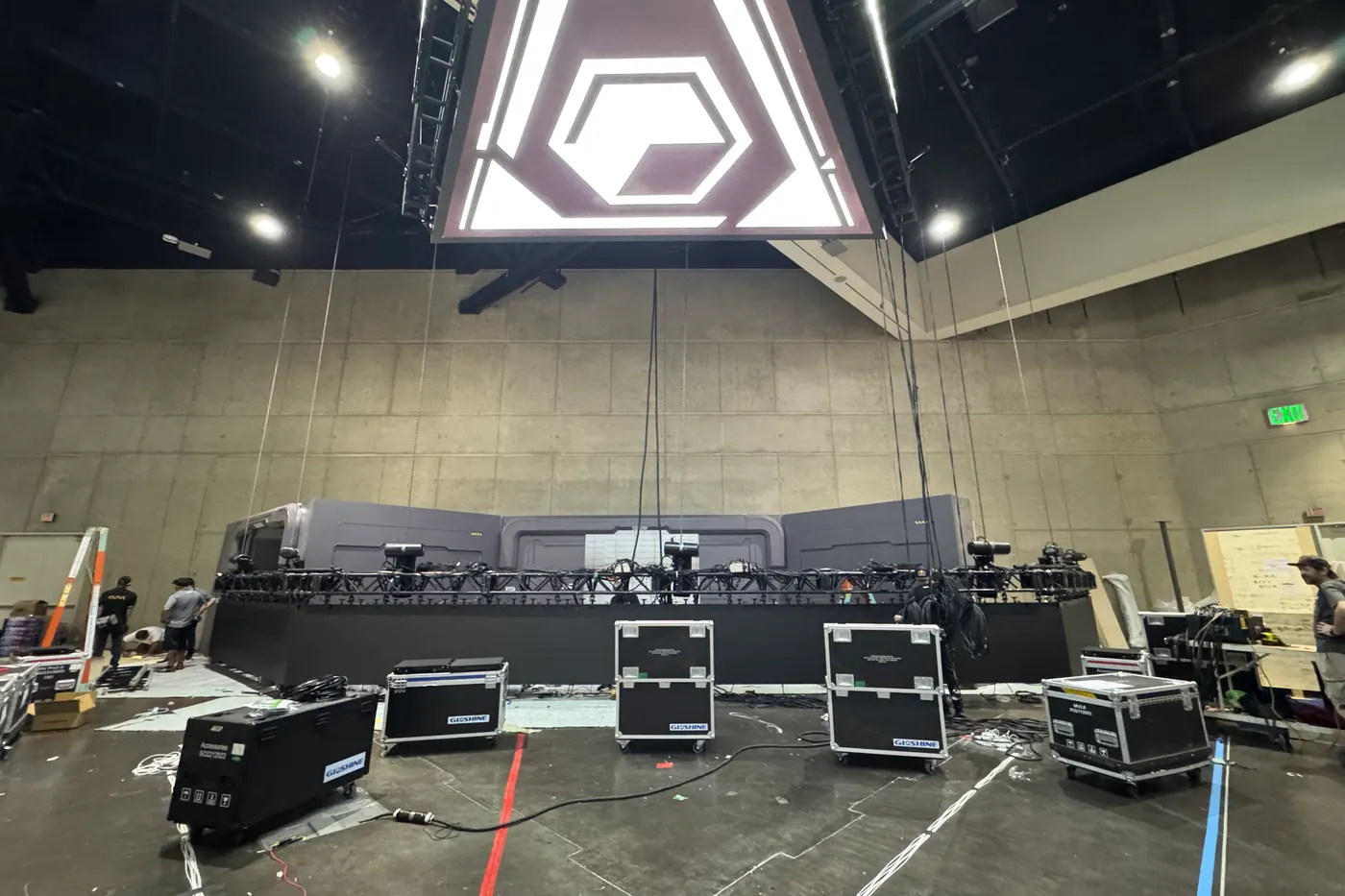
- How long is move-in? Halls allow little time: the build, the flying and the tests must fit the days the hall gives. The two walls below show how long a flown wall and a floor-standing one take.
- Who hangs the wall? At US halls the rigging points, truss and lifts usually belong to the hall’s appointed rigging contractor; an exhibitor cannot hang its own. We design the hanging structure, send the drawings ahead and adjust with the riggers on site.
- Which rules govern power and labor? Move-in, power and rigging follow the hall’s rules and its appointed contractors, and at union venues labor follows the venue’s requirements. Venues usually ask vendors for a certificate of insurance (COI), which we provide.
- Who guarantees the angles on a folded wall? Glasses-free 3D needs folds far tighter than riggers are used to, so someone has to own the angles on site (Comic-Con, below).
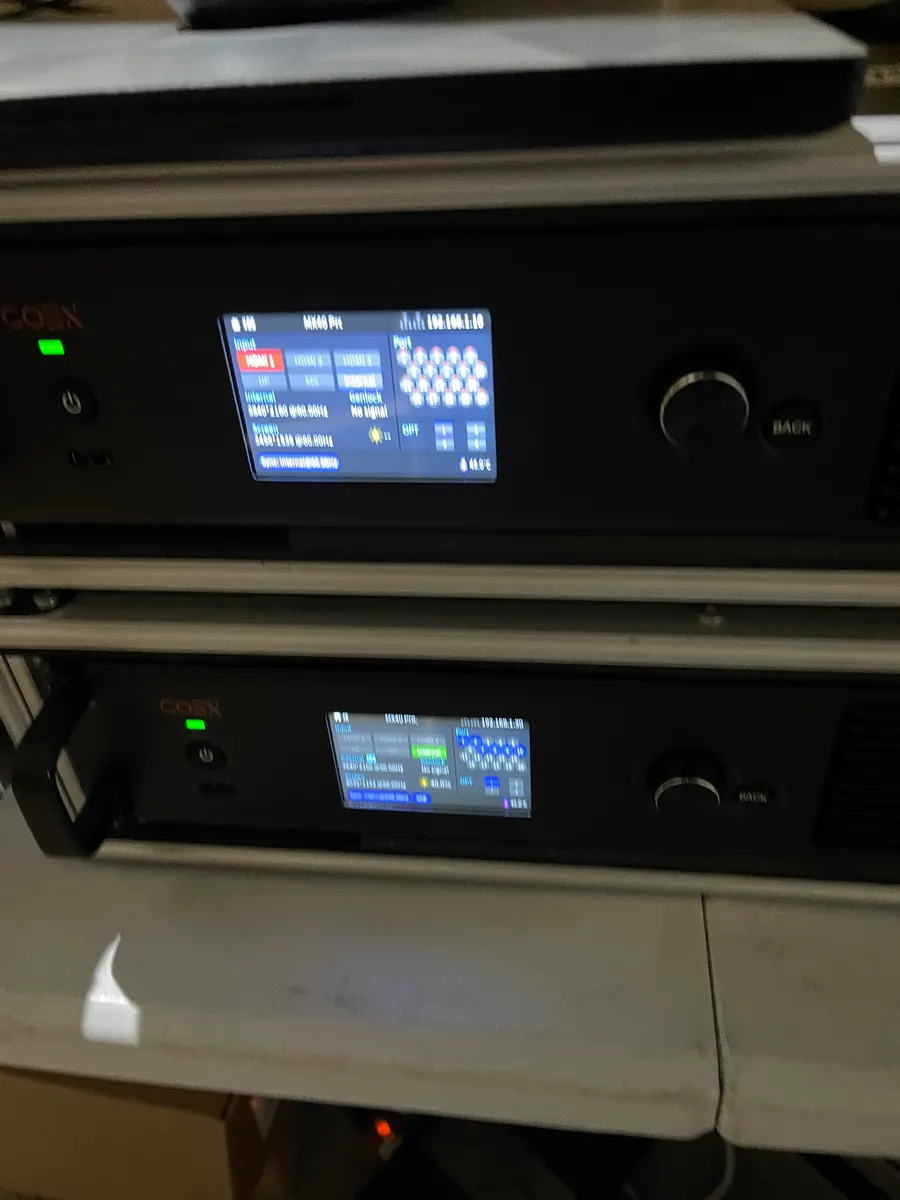
- Will two processors stay in step? A wide wall often runs from two processors, one per half, and the seam can tear. Lock both halves to a sync generator, as on our virtual production stage.
- Can the 3D content play smoothly? Glasses-free 3D files are very large and stutter on an ordinary computer. Play them from media servers, with the content prepared to the show’s running order.
- What if a processor fails? A show lasts a few days, with no time to wait for a repair. Keep processors on hot standby, so a failed one is swapped at once.
San Diego Comic-Con 2025: a 24 m glasses-free 3D wall, flown
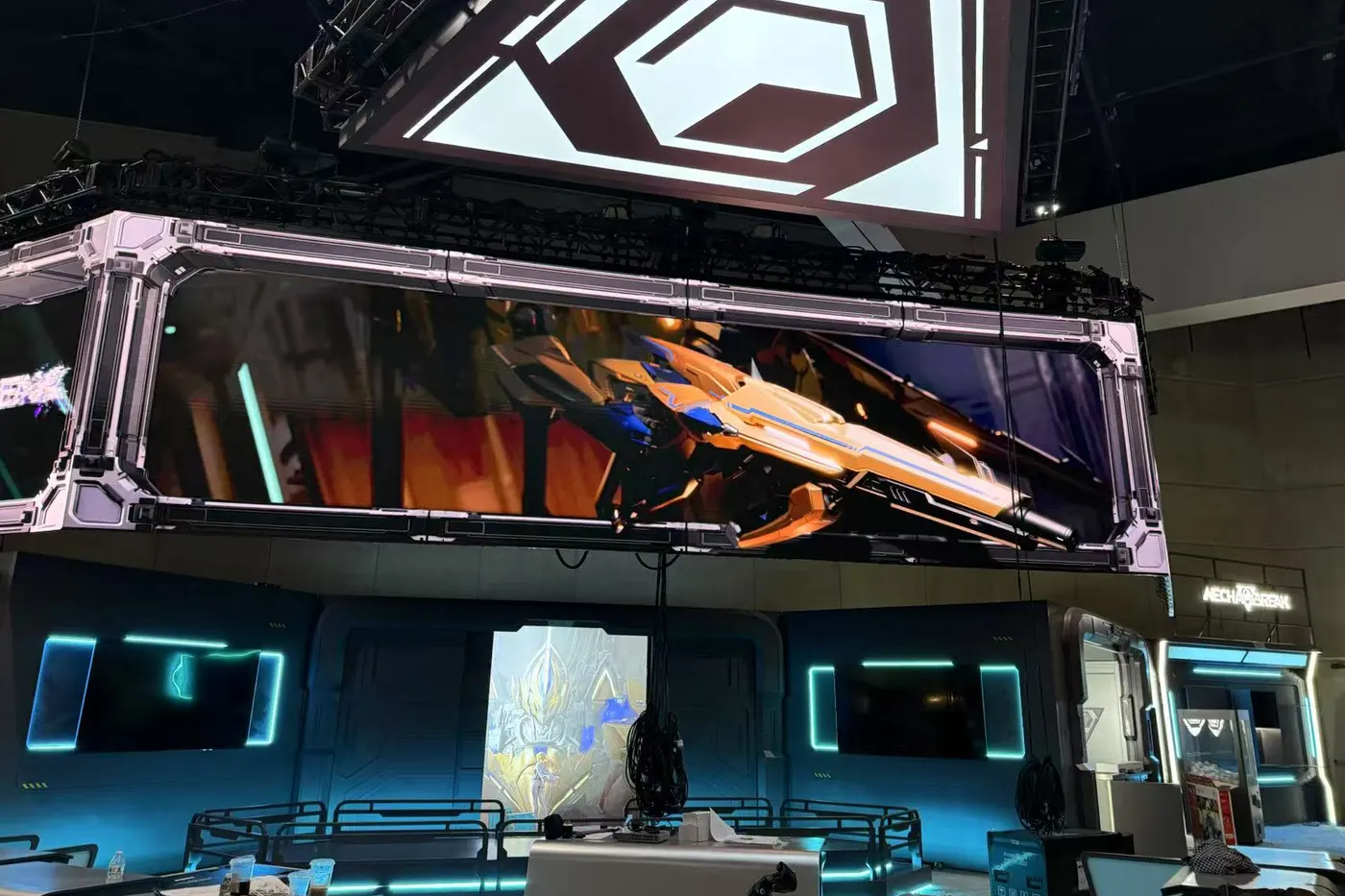
July 2025, San Diego Convention Center: move-in from July 20, show open on July 24. For a video game booth we designed, supplied and ran a flown wall 24 m long and 3 m high in three sections: an 11 m main screen with a 6.5 m wing on each side at 135°, 288 Gloshine MV Pro 2.6 cabinets at 7,680 Hz.
The hall’s appointed rigging contractor supplied the truss and points; we designed the hanging structure and supplied the drawings. Riggers are used to about ±10°; together we spent six hours bringing the folds to the ±1° the 3D effect needs, with bevel-cut corner cabinets from the same production batch as the rest of the wall. A sync generator locked the two halves, Hirender S3 media servers played the client’s 3D content, and four NovaStar MX40 Pro processors ran two live and two on hot standby, so any one could be swapped at once.
NAB Show, Las Vegas: Hollyland’s booth wall, three years running
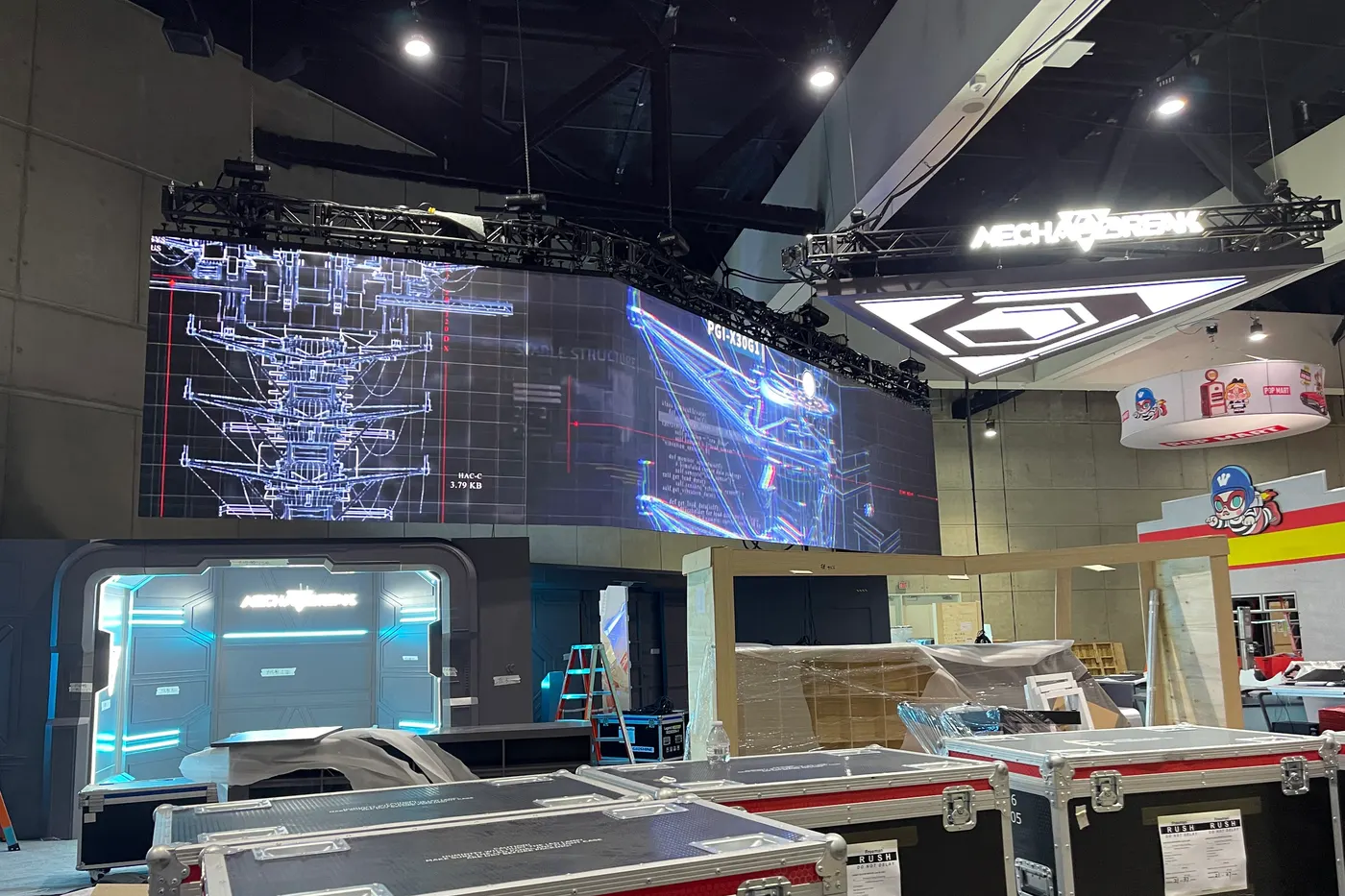
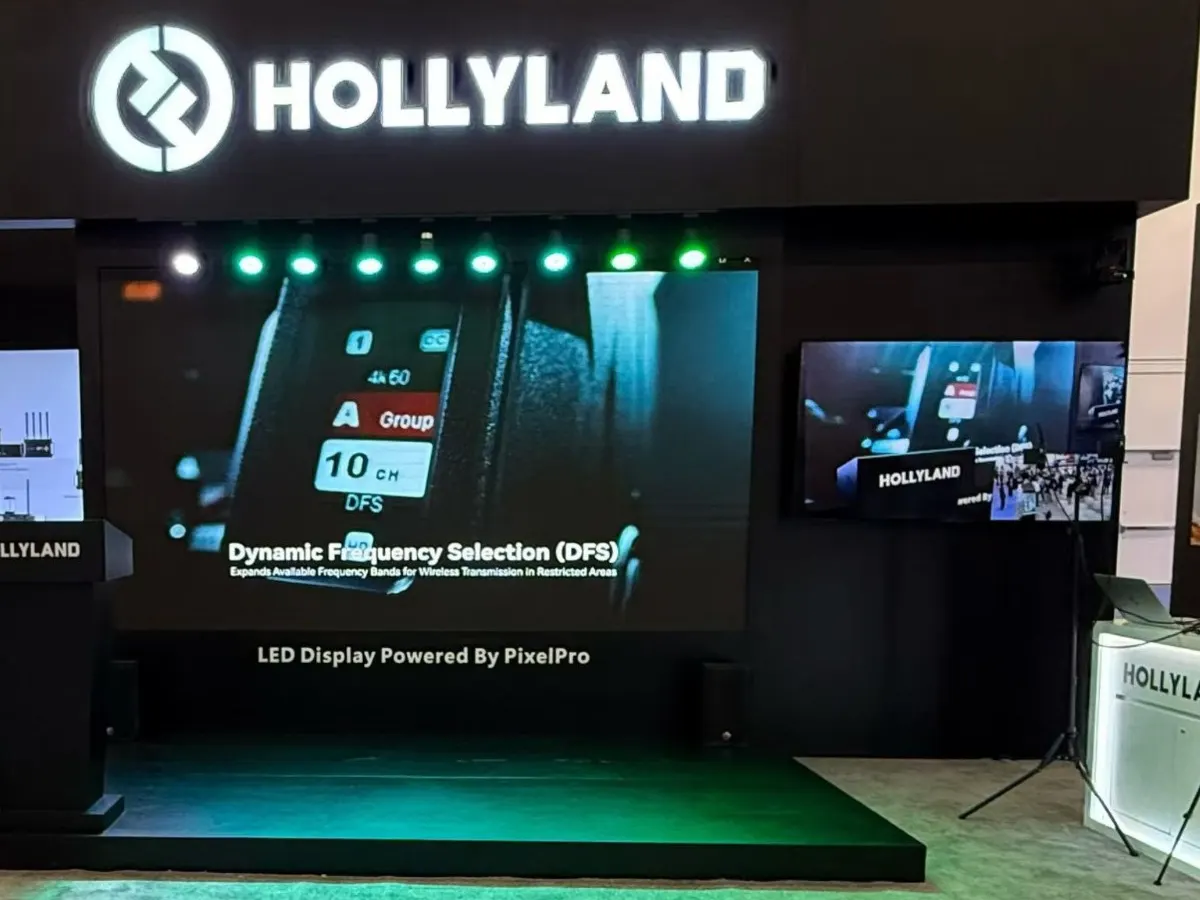
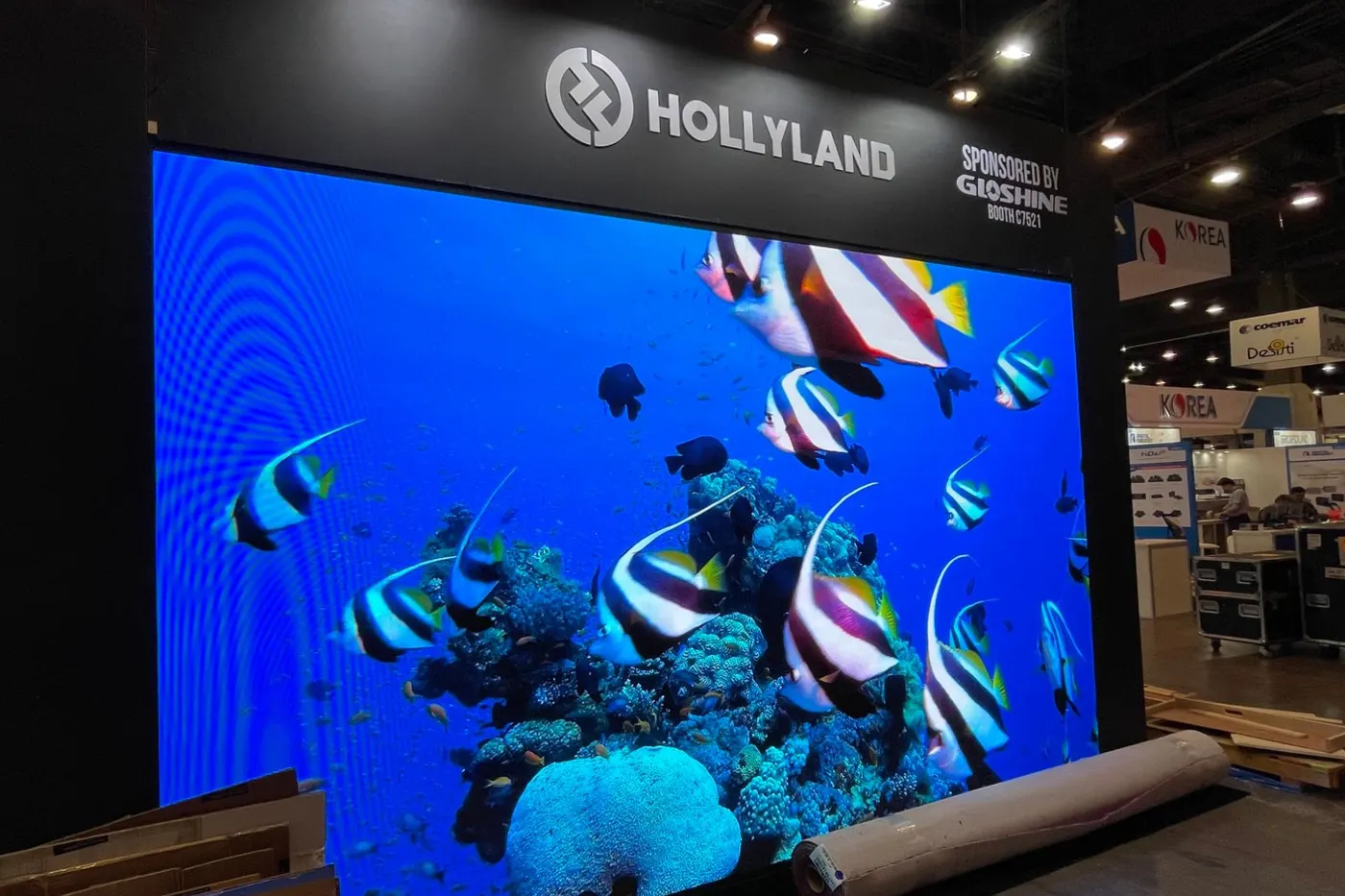
At NAB Show 2024, 2025 and 2026 we supplied the LED wall in the booth of Hollyland, the Shenzhen maker of wireless video and audio gear: 5.5 × 3 m of Gloshine MV Pro 2.6, 66 cabinets, standing on the floor and run from a NovaStar VX1000. It goes up in one day.
The booth, its lighting and its sound came from the exhibitor and its booth builder; we supplied only the wall. It sits behind the booth’s presentation stage, where speakers present in front of it.
Exhibiting from outside the US, or from out of state
A booth builder from Europe or Asia, or an exhibitor flying in from another state, does not need to bring an LED wall. Ours are in Anaheim, California, with the processors and spares, so nothing goes through customs and nothing is shipped across an ocean. To Southern California and Las Vegas we drive the wall in our own truck; to San Francisco we ship it to the show.
Ask your show for these, early. Each one is in the exhibitor kit, and each one changes the plan for an LED wall:
- Labor rules. Who may assemble an LED wall: your crew, ours, or the hall’s union crews.
- Contractor registration. The deadline to name us as your exhibitor-appointed contractor, and the insurance we must show.
- Power. The electrical contractor and the deadline for advance prices.
- Rigging and booth plans. What must be sent, by when, and whether a tall or flown wall needs an engineer’s stamp.
Send us these for a quote. We reply with what we can take on and a price:
- The show, the venue, the hall and the booth number.
- The booth drawings, or the booth size.
- The wall’s size, or what it should show.
- Move-in and move-out times.
- Floor-standing or flown.
- Who builds the booth.
- The format of your content.
We invoice in US dollars, by wire or card. Our crew speaks English and Mandarin.
Five convention centers, compared
The same LED wall goes up under different rules in each hall. From each venue’s own guides, as of November 2026:
| Venue | AV company | Who builds the wall | Power | Rigging plans |
|---|---|---|---|---|
| Anaheim Convention Center | Encore preferred, not exclusive | The venue does not require union labor; check the show | An electrician on the ACC’s approved list | To Encore 30 days ahead |
| Los Angeles Convention Center | Your choice, approved per event | Union crafts on the floor: Local 831, Teamsters 986, IBEW, IATSE 33 | The show’s authorized electrical contractor | The show’s authorized rigger; walls over 15 ft need a city permit |
| San Diego Convention Center | ON Site preferred, not exclusive | Union jurisdiction agreement, set per event | An approved contractor or the show’s contractor; the venue supplies none | ETCP-certified supervisor; flown work needs city safety training |
| Las Vegas Convention Center | None exclusive; each show sets it | Per show: at NAB Show 2027, electricians assemble LED tiles | The show’s electrical contractor | 14 days ahead; electric hoists only |
| Moscone Center, San Francisco | Projection preferred, not exclusive | Union: Local 510 for exhibits, IATSE Local 16 for AV | The show’s electrical contractor, for 20 A and up | 30 days ahead for 1,000 lb and up |
Venue rules from each center’s facility guide and rules; the NAB Show line is a show rule for 2027. Rules change and shows add their own: check the exhibitor kit.
LED walls at the Anaheim Convention Center →
LED walls at the LA Convention Center →
LED walls at the San Diego Convention Center →
What we can do
PixelPro Productions is in Anaheim, California, with its own LED, processors and show control, and a crew that speaks English and Mandarin. We can supply a booth’s LED wall, product screens, lighting and sound directly, or work as the booth builder’s local subcontractor, in Las Vegas and other halls outside California too.
Booth builders: you build the booth, hand the LED and AV to a local team →
Questions
Can an exhibitor hang its own LED wall at a US trade show?
Usually not. At US halls the rigging points, truss and lifts are normally handled by the hall’s appointed rigging contractor. At San Diego Comic-Con 2025 PixelPro Productions designed the hanging structure and supplied the drawings, the hall’s rigging contractor supplied the truss, and together they brought the folds to within ±1°.
How far ahead should booth LED be booked?
As early as possible. The US trade show calendar is busiest from January on, when LED and crews book out. Send the hanging structure and drawings to the hall’s appointed rigger before move-in.
How long does a booth LED wall take to build?
Hollyland’s 5.5 × 3 m, 66-cabinet wall at NAB Show takes PixelPro Productions one day. The 24 m flown wall at San Diego Comic-Con 2025 used the four days of move-in before the show opened.
Can a booth builder hand only the LED to you?
Yes. PixelPro Productions can act as a booth builder’s local subcontractor for just the LED, lighting, sound or show control it needs, reviewing the builder’s drawings before move-in; if needed, we can appear on site under the builder’s name.
Do we need to ship an LED wall from our country to a US trade show?
No. You can rent one in the US. PixelPro Productions keeps its LED walls, processors and spares in Anaheim, California, and trucks them to shows in Southern California and Las Vegas, or ships them to San Francisco, so nothing goes through customs.
Can our own crew from abroad build the LED wall at a US convention center?
It depends on the hall and the show. The Anaheim Convention Center does not require union labor, though shows may. At Moscone Center in San Francisco union crews install video walls, and at NAB Show 2027 in Las Vegas electricians must assemble and power LED tiles. Check the exhibitor kit before planning the crew.
What insurance does a US trade show ask of an LED wall contractor?
A certificate of insurance naming the show and the venue as additional insureds; the limits are in the exhibitor kit. Some venues add their own rules: at the Las Vegas Convention Center, outside contractors also hold an annual LVCVA permit, with auto and workers’ comp cover. We issue a certificate for each show.
